Showing posts with label Elements. Show all posts

Friday, November 23, 2018

Whipple Library exhibition: Curating the Chemical Elements: Julius Lothar Meyer's Periodic Systems

"To celebrate the one event which will forever be associated with 2019 – yes, the UN & IUPAC’s Celebratory Year of the Periodic System of Elements – we are very pleased to announce the opening on Monday of our latest Whipple Library display. Curating the Chemical Elements: Julius Lothar Meyer’s Periodic Systems has been put together by HPS PhD student Karoliina Pulkkinen.

Karolina had this to say about the inspiration behind the exhibition:
The logo for the Un & IUPAC year depicts the “father of the periodic law”, Dmitrii Ivanovich Mendeleev, who is placed next to a chemical element named after him. As a researcher working on the history of periodic system, I want you to look at that picture, squint your eyes, and imagine another bearded man there instead of Mendeleev. I ask you to do this because there were in fact several other bearded men who could be placed on that logo.

Like historian Michael Gordin, who has written a marvellous book on Mendeleev, I confess that I have little idea of who actually discovered the periodic system of chemical elements. From all the bearded men that could be titled as its discoverers, however, I would like to direct attention to a German chemist called Julius Lothar Meyer in particular. This exhibition presents Meyer’s systematisation of the elements. Arguably, Meyer’s graphs give us the most striking early visualisation of the periodic relationship between the mass of the elements and their chemical properties.

Many a time have I felt grateful for conducting my historical investigations in 2015-2019 rather than fifteen, thirty, or fifty years earlier. Apart from being able to move from one European conference to another with relative ease, I can press Ctrl+F, follow electronic trails, and download a PDF of books put together by scholars of Soviet Union. The vast majority of the sources I needed were available from the first week of my PhD.

But some things are best studied in life rather than on screen. Things too fragile, or too inconveniently put together for scanners and cameras. One such thing is Lothar Meyer’s graph showing the periodicity of chemical elements.

You would struggle to find a digitisation that shows its full scope and detail online, and big thanks are due to the staff at the Chemistry Library and Conservation at the UL for providing us with the original document. One can try to show it all on screen, (and together with the staff of Whipple, we have tried to ensure a Comfortable Online Viewing Experience), but you should come over to Free School Lane and have a look yourself. If I had the resources, I would put it on a bus: here at Whipple, you will learn something about the experts who you will not get enough of!

The exhibition is taking place in the usual cases on Level 1 of the Haycock Theatre at the Whipple Library, and can be viewed by anyone during library opening hours. We have also put together a virtual exhibition, which you can view here: https://www.whipplelib.hps.cam.ac.uk/special/exhibitions-and-displays/curating-chemical-elements

The exhibition will be on until March 2019, and we hope as many of you as possible will be able to stop by and enjoy!"

Monday, May 21, 2018

4th June - Elementary Poetry Workshop...and end of year party!


All are welcome to join us to celebrate the end of our elements series with a found poetry workshop using all of the texts we have read and discussed over the previous two academic years. See here for an online introduction to found poetry, and examples.

We meet on Monday 4th June in the Newnham Grange Seminar Room at Darwin College, from 7.30–9pm.

See you then!

Tuesday, April 10, 2018

Easter Term 2018 - Aether (take 2)

The Science and Literature Reading Group will hold two sessions which were postponed from last term due to industrial action. We first complete our explorations of the aether by looking at the theme of communication, across and beyond the globe. We will then celebrate the end of our elements series with a found poetry workshop using all of the texts we have read and discussed over the previous two academic years.

All are welcome to join in our wide-ranging and friendly conversations, which take place in the Newnham Grange Seminar Room at Darwin College on selected Monday evenings from 7.30–9pm. The group is organised by Melanie Keene and Charissa Varma.

For recaps, further readings, news, and other updates, please follow us on Twitter @scilitreadgrp or check this blog.

14th May – Communication


4th June – End of year party and Elementary Poetry workshop

Tuesday, February 06, 2018

26th February - Communication


For the final meeting discussing the aether, we will take to the airwaves, reading three pieces which in different ways consider the consequences of communicating across (and even beyond) the globe:
We will meet once again in the Newnham Grange Seminar Room at Darwin College. All welcome!

Monday, January 29, 2018

5th February - Connection

Our second meeting of term willl take place from 7.30-9pm in the Newnham Grange Seminar Room at Darwin College (left along the corridor from the Porters' Lodge, and up the carpeted staircase, passing the bust of Charles Darwin).

We focus on two readings which consider the ways in which ethereal connections were made and discussed in the early twentieth century:
All welcome!

Tuesday, January 09, 2018

Lent Term 2018 - Aether


Following our tour of the four classical elements, this term the Science and Literature Reading Group looks to the fifth: aether. Our first three meetings focus on ways in which ethereal concepts have been used: as a vehicle for the imagination; as a medium for interconnection; and as a means of communication. The final meeting will celebrate completing the elementary series with a found poetry workshop using all of the texts we have read and discussed over the past year.

All are welcome to join in our wide-ranging and friendly conversations, which take place at Darwin College on selected Monday evenings from 7.30–9pm. The group is organised by Melanie Keene and Charissa Varma.

For recaps, further readings, news, and other updates, please follow us on Twitter @scilitreadgrp or follow this blog.

22nd January – Imagination

5th February – Connection

26th February – Communication

12th March – Elementary Poetry workshop

Monday, November 27, 2017

Recap - Mud

Armed with appropriate refreshments and entertainment for the end-of-term party, we met for the final time in the wonderful Watson Gallery on Monday 27th November. We read and discussed a selection of poems which in different ways used mud, soil, or earth to contemplate themes of transience, nostalgia, mortality, embodiment, sensory engagement, warfare, regionality, ritual, heritage, and more. Many thanks to everyone for their thoughtful contributions to the conversation!

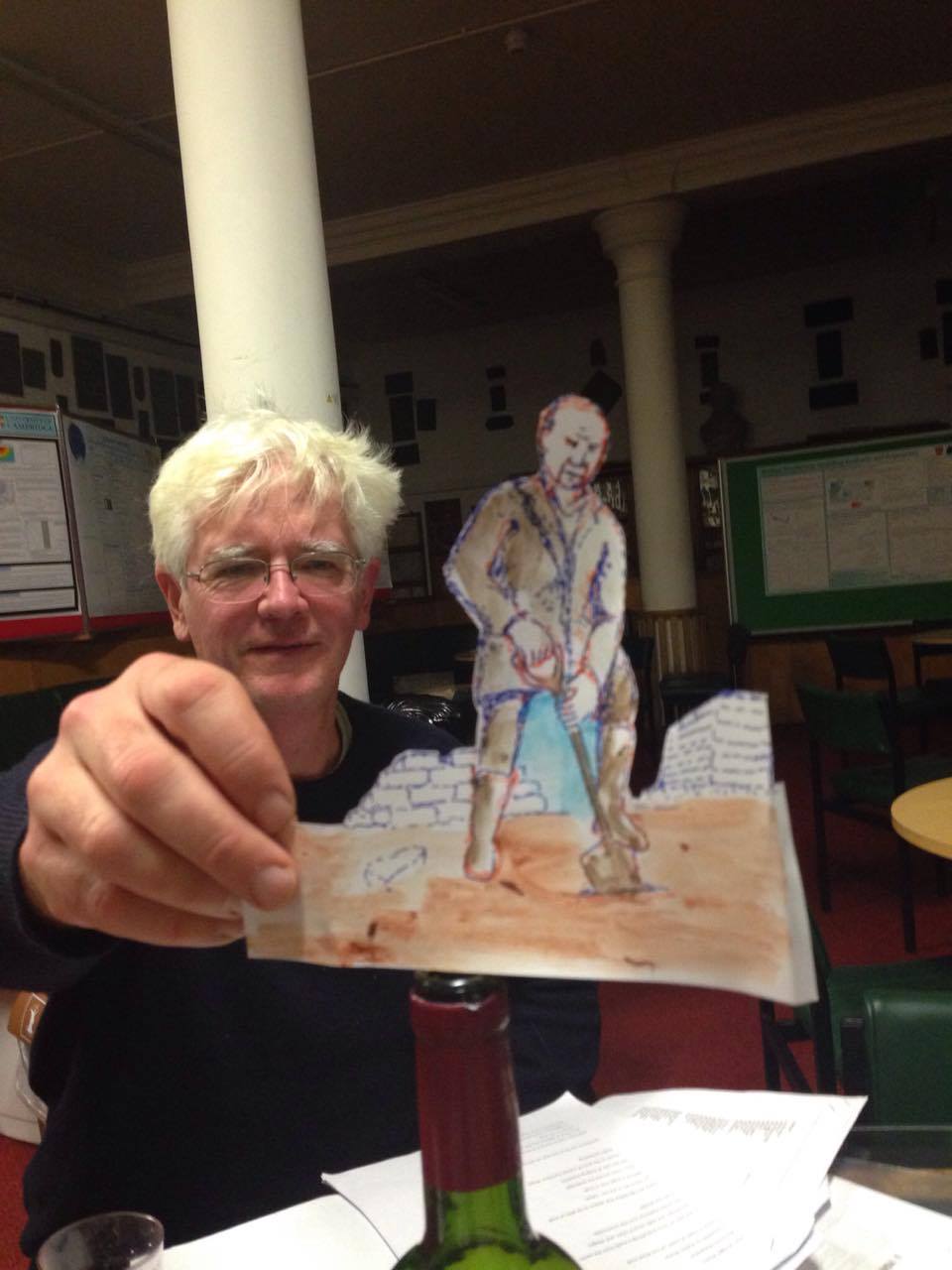
Below, Charissa's photos of Simon's poetic illustrations.


Wednesday, November 15, 2017

27th November - Mud


Our final meeting for Michaelmas 2017 - as well as our end-of-term party - will take place on Monday 27th November from 7.30-9pm in the Watson Gallery, Department of Earth Sciences.

We will be contemplating earthly poetics: mud as medium, metaphor, material. To prepare, please read as many poems from our muddy anthology as you'd like:
All welcome!

Recap - Mountain


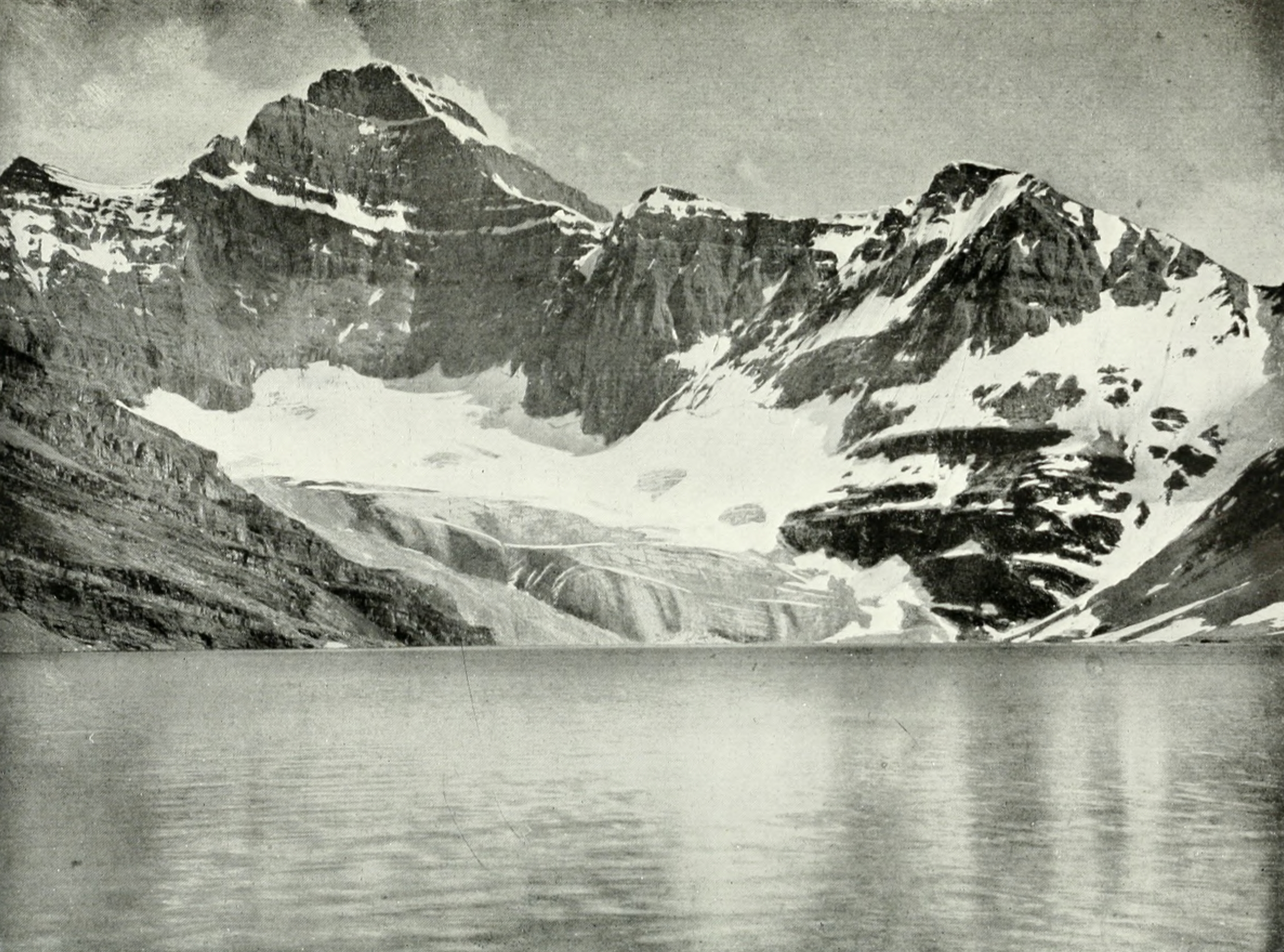
Our third meeting took place on a chilly Monday evening, which brought at least a hint of the Canadian climate to Cambridge. Charissa gave a fabulous, wide-ranging introduction to the set readings, putting them into a wider context of the role of mountains in geology and tourism; in ideas and ideals of masculinity and conquest; in the presence of women in the literary and photographic record of early 20th-century mountaineering; in the variety of ways in which women participated in climbing, photographing, collecting, reporting, or conversing; and through the particular biographies of some of the extraordinary women whose works we read.

We learned about the role groups such as the Alpine Club of Canada - from whose journal the selected readings were taken - had in putting a Canadian 'stamp' on mountaineering, ensuring that Canadians, too, could claim 'first' ascents. We learned of the social cohesiveness of these clubs, with most members being middle-class/professionals; and that there were a significant number of women who joined. We learned how the Canadian-Pacific railway made the Rockies newly accessible for trade, travel, and exploration, and how an economy was established along its route. 'The Alpine Club of Canada' gave a sense of the possibilities of patriotism and participation the group hoped to foster.


Considering the appreciation of mountains from the 18th/19thC as locations for especially picturesque or spiritual experiences, we compared how these women often spoke about their physical, tactile contact with mountains. Mountaineering was an overtly embodied endeavour (as 'A Graduating Climb' detailed): a combination of 'the flesh-stuff and the soul-stuff', which had - so these writers claimed - benefits for health, including for female bodies, as laid out by 'Mountain Climbing for Women'.

We discussed the different ways of writing about the mountains to be found in one journal - or even in one article. From the humour of Ethel Johns, to the scientific precision of 'Observations on Glaciers', or the wonderful photographic illustrations to 'Untrodden Ways', women's variegated mountain experiences were well captured in the writings. 'Untrodden Ways' also made mention of the First Nations peoples who lived, worked, and climbed in these regions, acknowledging their previous presence.

We looked in more detail at the biographies of Mary Vaux (see the marvellous photographs online at 'Mary M. Vaux: A Picture Journal': lots of wonderful mountaineering images; Her botanical illustrations are also on Wikipedia), Mary Schaffer (more on her here) and Mollie Adams, who suffered an unfortunate encounter with Rudyard Kipling, and Elizabeth Parker.

Overall, we felt privileged to have, through their writings, photographs, and records, joined these women on their ascents and adventures. Next time: mud, glorious mud.


Sunday, November 12, 2017


Wednesday, November 01, 2017

13th November - Mountain


Our third meeting of term features selections from early numbers of the Canadian Alpine Journal, in which several women discuss their experiences of climbing the Rockies. All are welcome to join us from 7.30-9pm in the Department of Earth Sciences! Suitable mountaineering apparel is not compulsory.

Recap - Ground

Edmond Halley advertises the Reading Group's meeting
Our second meeting of term ventured under the Earth's surface, as we discussed a classic of so-called 'Hollow Earth' fiction, paired with an argument for why there might plausibly be separate spheres held within our own terrestrial globe.

We explored how both texts used literary strategies to present their events or reasoning processes as likely extensions of currently-known observations, creatures, or societies. We thought about fantastical travel narratives and their relationships with other genres: how speculative fictions as well as tours of underworlds were used to frame understandings of what might be found underfoot. We saw how the two texts in question connected what we might call intraterrestrial writings with extraterrestrial writings, as the interior of the Earth was compared with other planets, whether Saturn's rings, the Moon, or new planets waiting to be discovered.

The evening ended with a wonderful tour of Simon's lab - and other highlights of the Department of Earth Sciences, including the dinosaur-clad library bookcases - where we were able to glimpse the current work ongoing to illuminate changes in the  Earth's magnetic field.

Next time we ascend the Canadian Rockies.

Tuesday, October 17, 2017

30th October - Ground


Our second meeting travels below the ground, as we look at two so-called 'Hollow Earth' writings, a travel narrative and a natural philosophical paper:
Additional relevant information can be found in this useful overview on 'Stories of a Hollow Earth' by Peter Fitting at the Public Domain Review.

Recap - Stone


We began our term's Earth-themed meetings with a discussion of the last two books of Pliny's Natural History, on stones and on precious stones, surrounded by the wonderful Watson Building Stones Collection. Sitting in front of many examples of Italian and Greek marble, our conversation ranged from amulets to amber, sanding to Sarcophagi, to the uses (and abuses) of classical statuary.

One of the most significant, lengthy, and complete ancient works, the Natural History attempted to be an encyclopaedic rendering of contemporary knowledge about the contents, origins, usages and properties of the natural world. Indeed, we found, the books were more than a catalogue of rocky descriptions, being accounts, stories, and recipes which dealt with stones in all their manifestations:
  • As part of a bigger natural whole
  • As sculpture, art, and buildings
  • As having intrinsic aesthetic properties
  • As coming from specific places
  • As useful: in processes, in remedies
  • As magical or marvellous
  • As mythical
  • As tasty
  • As fossils
  • As changeable
  • As similar and simile

Throughout, we considered three themes or questions on the compilation and presentation of natural knowledge, as the text exhibited differing voices, digressions, and tensions:
  • Authority: whose?
  • Description: how?
  • Meanings: why?
We closed our conversation with a passage describing the eruption of Vesuvius in which Pliny died - and which has proven to be an outstanding early description of a pyroclastic flow.

Next time we venture underground...

Making use of geological apparatus to sieve cork and sediment from wine...

Monday, October 16, 2017

16th October - Stone


We begin our earth-based readings with a fundamental exploration of stony natural history, reading two sections from Pliny's classic text: books XXXVI ('The Natural History of Stones') and XXXVII ('The Natural History of Precious Stones'). Given the late notice of the readings, please just look at as much of the text as you can.

We'll meet from 7.30-9pm in our new venue, the Watson Gallery:
Enter the Downing Site and go to the Earth Sciences entrance below the steps to come in, ie not the museum entrance but the departmental entrance below it. If you find yourself locked out of the building, attendess can get themselves let in by waving outside the big arched ground floor windows on the Downing Site, beyond the steps with the stone bears, where the Anglo-Saxon sarcophaguses stand.
Hope to see many of you tonight!

Michaelmas Term 2017 - Earth


This term the Science and Literature Reading Group gets down to earth. We will complete our cycle of themes based on the four ancient elements by exploring how different authors have tackled terrestrial topics, from muddy slimescapes to sublime mountain-top.

We are delighted to meet in an appropriate new venue: the Watson Gallery of the Department of Earth Sciences. Many thanks to Simon Crowhurst for arranging this! Directions can be found at the bottom of this post.

All are welcome to join in our wide-ranging and friendly discussions, which take place fortnightly on Monday evenings from 7.30-9pm.


16th October - Stone


 30th October - Ground


13th November - Mountain


27th November - Mud
Read as many poems from our muddy anthology as you'd like:


Directions to the Watson Gallery:
Enter the Downing Site and go to the Earth Sciences entrance below the steps to come in, i.e. not the museum entrance but the departmental entrance below it. If you find yourself locked out of the building, attendess can get themselves let in by waving outside the big arched ground floor windows on the Downing Site, beyond the steps with the stone bears, where the Anglo-Saxon sarcophaguses stand.