Showing posts with label Sun. Show all posts

Wednesday, March 18, 2015

Recap - Blinded by the Sun

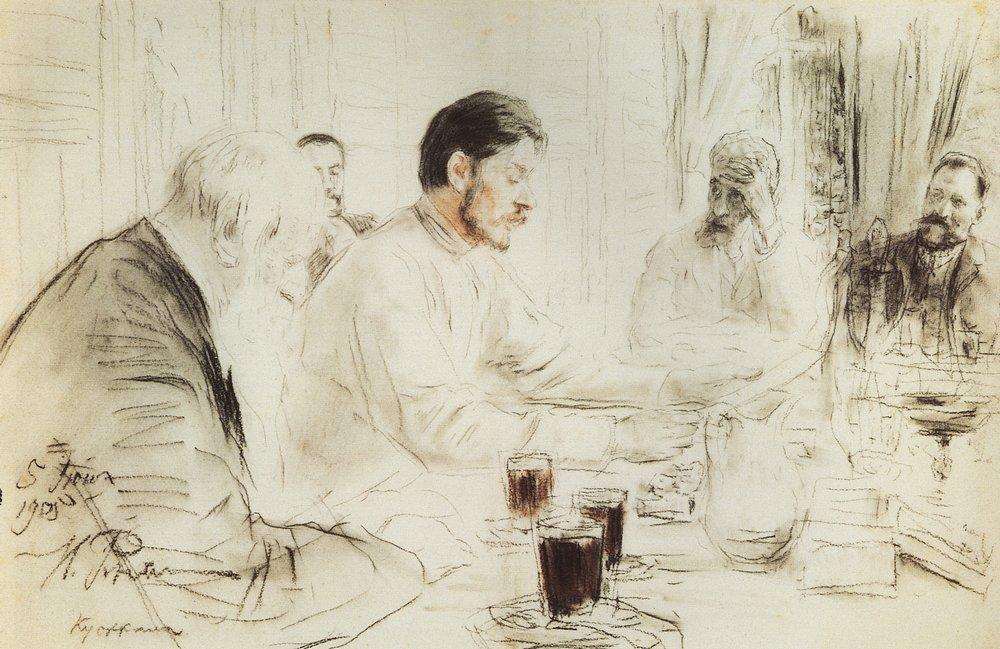
Characters from the play 'live-sketched' by Simon during Adrian's introduction.

At our second - and last - meeting of term we discussed Stephen Poliakoff's Blinded by the Sun (1996). After dishing out the cake and drinks (not quite the picnic fare represented in the play...), Adrian provided an excellent and thorough introduction to Poliakoff, his work, and even his family.

Alongside Arcadia (1993) and Copenhagen (1998), Blinded by the Sun formed, we learned, the middle of a trio of science plays produced by the National in the 'nineties. Arguably the least well known of these plays, it is also the only one in which, as its opening instructions say, 'The time is the present' throughout. Is this best, therefore, seen as an 'unhappy state of the nation' play?

Adrian identified the key themes of the play's attempt to gain insight into the workings of academia and its relationship with wider society: how, it asks, do science departments response to the world? What does the world want from them, and what do they want from the world? What does the world reward in the sciences and what does it not reward? What do science departments themselves value and/or reward? With Poliakoff's brother a chemistry professor at Nottingham, we felt the playwright had a particular connection to these topics. Scrutiny of the current website of the Nottingham chemistry department shows its quite evident placement in relation to wider audiences, with emphases on student satisfaction and sustainable chemistry ('benign by design').

Guided by Adrian, we also thought about replication and reputations in science, with reference to the cold fusion controversy of the late nineteen-eighties. Does, as the play seem to suggest, a focus on sensational frauds miss many other forms of misconduct or betraying of ideals as part of scientific practice? At several points in the play we felt its characters expressed well the frustrations, insights, and experience of actually conducting scientific research; the different personalities involved seemed to stand in for different types (and generations) of researchers.

The discussion continued to cover everything from perpetual motion machines to detergent. In particular, we talked about several pairs of topics: pure and applied science, individual and group research, gender and careers, counterfeiting and skill, cognitive dissonance and fraud, inspiration and perspiration. A fitting conclusion to our term focussing on this pair of plays.

Tuesday, February 10, 2015

2nd March - Blinded by the Sun

The second meeting of the Science and Literature Reading Group for this term will take place on Monday 2nd March in the Newnham Grange Seminar Room at Darwin College. Please note the different location from the last session.

We will read Stephen Poliakoff's 'Blinded by the Sun' (1996) - the play is available in the University Library and a copy will also be put in the Whipple Library box file soon. In preparation for the meeting, Adrian has suggested we read up on cold fusion, and also visit the home page of the University of Nottingham School of Chemistry. Intriguing...

Recap - Children of the Sun


Our pair of theatrical meetings began in style, with one of the most interdisciplinary gatherings of readers yet. After a brief introduction to the main themes of the term, we considered the origins of Maxim Gorky's Children of the Sun, written whilst he was imprisoned in 1905: its connections to contemporary revolutionary movements, and as part of Gorky's oeuvre of politically-engaged literature. Many aspects of the play's plot and characterisation, we felt, could be read as commentary on Tsarist Russian society, from the unsustainable complacency and dilletantism of the bourgeoisie, to the restless mob just off stage. (Famously, on the play's premiere the audience panicked, associating the feigned unrest with an actual assault on the theatre.) Though Gorky has been held up as a champion of socialist realism, and his later related interests in biology, aesthetics, and transfigured reality have been highlighted, we felt that his play was not so easily categorised: its playful, almost farcial elements seemed more like pantomime than sober reality.

We also explored the play's nineteenth-century setting, and its connections to earlier literature: Ibsen's An Enemy of the People was an evident point of comparison, another piece dealing with relationships between a scientific figure and wider society, purity and contamination. Turgenev's Fathers and Sons seemed to one participant at least to be an obvious model that Gorky was referencing, confident in his audience's familiarity with the classic work. Indeed, the very year of Fathers and Sons's publication, 1862, was the setting for Children of the Sun. Chekhov and Bulgakov were also fruitfully drawn upon.

Further themes of discussion included the similarities and differences between the speeches, poems, and described paintings in the play, and their associated dramatis personae of man of science, poet, and artist: were some sources of inspiration and dedication to pursuits more insightful or worthy than others? How the sun figured throughout the drama was also discussed, as was the provision and playful destruction of the eggs, and some of the ambiguities of Gorky's characterisation: Protasov could be portrayed in very different ways, according to how one wanted to read or stage the play.

We also considered the role of the man of science, as presented by the play: was it admirable and visionary to focus on the future of humanity, or selfish to neglect the humans in your near vicinity? Should figures self-abnegate before the scientific genius, or see scholarly isolation as a naive retreat from the problems of the commonplace and common people? Broadening out our discussion, we explored more general representations of scientific figures in literature and film, wondering about the (im)possibility of showing creativity on page or screen; whether ; and even whether such stories were more productively conceived of as superhero narratives.

Some further readings, mentioned by group participants:

Monday, January 05, 2015

Lent Term 2015 - A pair of plays


http://i.guim.co.uk/static/w-620/h--/q-95/sys-images/Arts/Arts_/Pictures/2013/4/17/1366194685791/Children-of-the-Sun-011.jpg

This term we will read a pair of plays which in different ways address the role and responsibilities of the man of science. Both readings are available in the University Library, and copies will also be placed at the beginning of term in the Whipple Library box file.

We meet at Darwin College on Monday evenings from 7.30–9pm. All are very welcome to join us!

9th February - Maxim Gorky, ‘Children of the Sun’ (1905)
Meet in the No.1 Newnham Terrace Upstairs Seminar Room

2nd March - Stephen Poliakoff, ‘Blinded by the Sun’ (1996)
Meet in the Newnham Grange Seminar Room