Barcelona, Institut d’Estudis Catalans, September 2-4, 2015.
Vilanova i la Geltrú, Biblioteca-Museu Víctor Balaguer, September 5th, 2015.
'Science and Fiction: A Creative Exploration of Real and Fantastic Worlds', is an International conference hosted by the Catalan Society for History of Science and Technology and the Catalan Society for SF and Fantasy. The main goal of the conference is to analyze and discuss the relations between science and fiction (literature, theatre, cinema, arts…), introducing them in the topics of the Catalan academic environment.
Topics proposed
Science & Fiction. 2. SF in university academics. 3. SF and genre writing. 4. SF in the international scene. 5. SF outside the books.
Proposals should include an abstract of 200 words, the author’s name, a short CV, and a tentative title. Please submit abstracts via e-mail to inscripcions.CienciaiFiccio@gmail.com by March 31st, 2015.
The official languages of the Conference are English and Romance languages.
Further details here.
Sunday, February 15, 2015

Tuesday, February 10, 2015
Report - Histories of the Future workshop
Very interesting write-up here of a recent workshop on Histories of the Future.
Talk - The Wonky Wheel of Eccentricity, and how it drives the Ice Ages
Friday 13th February 2015, 7:30 pm, Ely Museum
Simon Crowhurst, Dept. of Earth Sciences, University of Cambridge
The great oscillations between warm interglacials and cold glacials in Earth's planetary climate over the last million years have occurred in pace with the periodicities of Earth's major orbital cycles: eccentricity, obliquity, and precession. A long-running problem for the Milankovitch theory - which states that climate cycles are paced by the planetary orbital configuration - has been that the difference in the radiation budget associated with the longest of these cycles - orbital eccentricity - appears too weak to explain its dramatic climate impact. New data obtained in Cambridge from the southern ocean suggests that there may be a more integrated way of understanding how our planet has responded to this orbital component; and this may be relevant to understanding the effects of eccentricity on other planets, and their moons.
The Vernon Cross Meeting Room is part of a self-contained wing at the back of the museum. The address is: The Old Gaol, Market Street, Ely, CB7 4LS. Note: the meeting room has it own entrance, at the back of the museum. The museum itself will be locked at night. The museum is at the top of Market Street, on the corner with Lynn Road. The council car park, next to the museum and meeting room entrance, should be available for public use in the evening. The St Mary's St. and Nutholt Lane public car parks are nearby. http://www.elymuseum.org.uk/
Simon Crowhurst, Dept. of Earth Sciences, University of Cambridge
The great oscillations between warm interglacials and cold glacials in Earth's planetary climate over the last million years have occurred in pace with the periodicities of Earth's major orbital cycles: eccentricity, obliquity, and precession. A long-running problem for the Milankovitch theory - which states that climate cycles are paced by the planetary orbital configuration - has been that the difference in the radiation budget associated with the longest of these cycles - orbital eccentricity - appears too weak to explain its dramatic climate impact. New data obtained in Cambridge from the southern ocean suggests that there may be a more integrated way of understanding how our planet has responded to this orbital component; and this may be relevant to understanding the effects of eccentricity on other planets, and their moons.
The Vernon Cross Meeting Room is part of a self-contained wing at the back of the museum. The address is: The Old Gaol, Market Street, Ely, CB7 4LS. Note: the meeting room has it own entrance, at the back of the museum. The museum itself will be locked at night. The museum is at the top of Market Street, on the corner with Lynn Road. The council car park, next to the museum and meeting room entrance, should be available for public use in the evening. The St Mary's St. and Nutholt Lane public car parks are nearby. http://www.elymuseum.org.uk/
2nd March - Blinded by the Sun
The second meeting of the Science and Literature Reading Group for this term will take place on Monday 2nd March in the Newnham Grange Seminar Room at Darwin College. Please note the different location from the last session.
We will read Stephen Poliakoff's 'Blinded by the Sun' (1996) - the play is available in the University Library and a copy will also be put in the Whipple Library box file soon. In preparation for the meeting, Adrian has suggested we read up on cold fusion, and also visit the home page of the University of Nottingham School of Chemistry. Intriguing...
We will read Stephen Poliakoff's 'Blinded by the Sun' (1996) - the play is available in the University Library and a copy will also be put in the Whipple Library box file soon. In preparation for the meeting, Adrian has suggested we read up on cold fusion, and also visit the home page of the University of Nottingham School of Chemistry. Intriguing...
Recap - Children of the Sun
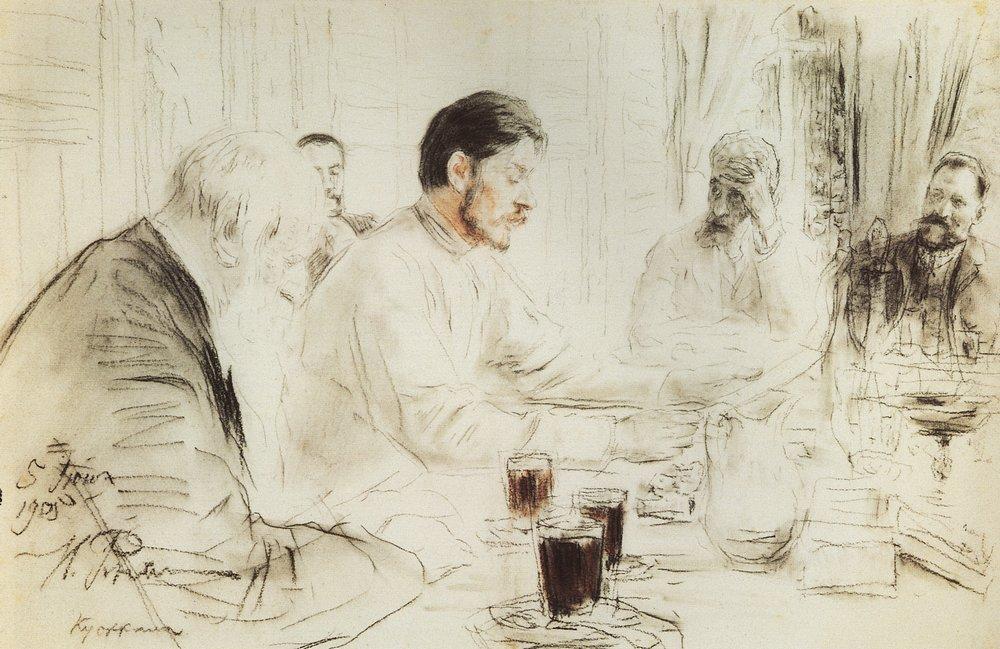
Our pair of theatrical meetings began in style, with one of the most interdisciplinary gatherings of readers yet. After a brief introduction to the main themes of the term, we considered the origins of Maxim Gorky's Children of the Sun, written whilst he was imprisoned in 1905: its connections to contemporary revolutionary movements, and as part of Gorky's oeuvre of politically-engaged literature. Many aspects of the play's plot and characterisation, we felt, could be read as commentary on Tsarist Russian society, from the unsustainable complacency and dilletantism of the bourgeoisie, to the restless mob just off stage. (Famously, on the play's premiere the audience panicked, associating the feigned unrest with an actual assault on the theatre.) Though Gorky has been held up as a champion of socialist realism, and his later related interests in biology, aesthetics, and transfigured reality have been highlighted, we felt that his play was not so easily categorised: its playful, almost farcial elements seemed more like pantomime than sober reality.
We also explored the play's nineteenth-century setting, and its connections to earlier literature: Ibsen's An Enemy of the People was an evident point of comparison, another piece dealing with relationships between a scientific figure and wider society, purity and contamination. Turgenev's Fathers and Sons seemed to one participant at least to be an obvious model that Gorky was referencing, confident in his audience's familiarity with the classic work. Indeed, the very year of Fathers and Sons's publication, 1862, was the setting for Children of the Sun. Chekhov and Bulgakov were also fruitfully drawn upon.
Further themes of discussion included the similarities and differences between the speeches, poems, and described paintings in the play, and their associated dramatis personae of man of science, poet, and artist: were some sources of inspiration and dedication to pursuits more insightful or worthy than others? How the sun figured throughout the drama was also discussed, as was the provision and playful destruction of the eggs, and some of the ambiguities of Gorky's characterisation: Protasov could be portrayed in very different ways, according to how one wanted to read or stage the play.
We also considered the role of the man of science, as presented by the play: was it admirable and visionary to focus on the future of humanity, or selfish to neglect the humans in your near vicinity? Should figures self-abnegate before the scientific genius, or see scholarly isolation as a naive retreat from the problems of the commonplace and common people? Broadening out our discussion, we explored more general representations of scientific figures in literature and film, wondering about the (im)possibility of showing creativity on page or screen; whether ; and even whether such stories were more productively conceived of as superhero narratives.
Some further readings, mentioned by group participants:
- David Foster Wallace, 'Rhetoric and the Math Melodrama' (£)
- Helene Mialet, Hawking Incorporated
- Sydney Padua, The Thrilling Adventures of Lovelace and Babbage (web and book)
- Marianne Moore on the poet and scientist being willing to 'waste effort'
Thursday, February 05, 2015
Aeon magazine article - 'Absolute English'
Science once communicated in a polyglot of tongues, but now English rules alone. How did this happen – and at what cost? Michael Gordin investigates here.
The Total Archive - Dreams of Universal Knowledge from the Encyclopaedia to Big Data
19 March 2015 - 20 March 2015, CRASSH
Boris Jardine (University of Cambridge)
Matthew Drage (University of Cambridge)
Ruth Horry (University of Cambridge)
The complete system of knowledge is a standard trope of science fiction, a techno-utopian dream and an aesthetic ideal. It is Solomon’s House, the Encyclopaedia and the Museum. It is also an ideology – of Enlightenment, High Modernism and absolute governance.
Far from ending the dream of a total archive, twentieth-century positivist rationality brought it ever closer. From Paul Otlet’s Mundaneum to Mass-Observation, from the Unity of Science movement to Isaac Asimov’s Encyclopedia Galactica, from the Whole Earth Catalog to Wikipedia, the dream of universal knowledge dies hard. These projects triumphantly burst their own bounds, generating more archival material, more information, than can ever be processed. When it encounters well defined areas – the sportsfield or the model organism – the total archive tracks every movement of every player, of recording every gene and mutation. Increasingly this approach is inverted: databases are linked; quantities are demanded where only qualities existed before. The Human Genome Project is the most famous, but now there are countless databases demanding ever more varied input. Here the question of what is excluded becomes central.
The total archive is a political tool. It encompasses population statistics, GDP, indices of the Standard of Living and the international ideology of UNESCO, the WHO, the free market and, most recently, Big Data. The information-gathering practices of statecraft are the total archive par excellence, carrying the potential to transfer power into the open fields of economics and law – or divest it into the hands of criminals, researchers and activists.
Questions of the total archive they engage key issues in the philosophy of classification, the poetics of the universal, the ideology of surveillance and the technologies of information retrieval. What are the social structures and political dynamics required to sustain total archives, and what are the temporalities implied by such projects? In order to confront the ideology and increasing reality of interconnected data-sets and communication technologies we need a robust conceptual framework – one that does not sacrifice historical nuance for the ability to speculate. This conference brings together scholars from a wide range of fields to discuss the aesthetics and political reality of the total archive
Registration now open here.
Boris Jardine (University of Cambridge)
Matthew Drage (University of Cambridge)
Ruth Horry (University of Cambridge)
The complete system of knowledge is a standard trope of science fiction, a techno-utopian dream and an aesthetic ideal. It is Solomon’s House, the Encyclopaedia and the Museum. It is also an ideology – of Enlightenment, High Modernism and absolute governance.
Far from ending the dream of a total archive, twentieth-century positivist rationality brought it ever closer. From Paul Otlet’s Mundaneum to Mass-Observation, from the Unity of Science movement to Isaac Asimov’s Encyclopedia Galactica, from the Whole Earth Catalog to Wikipedia, the dream of universal knowledge dies hard. These projects triumphantly burst their own bounds, generating more archival material, more information, than can ever be processed. When it encounters well defined areas – the sportsfield or the model organism – the total archive tracks every movement of every player, of recording every gene and mutation. Increasingly this approach is inverted: databases are linked; quantities are demanded where only qualities existed before. The Human Genome Project is the most famous, but now there are countless databases demanding ever more varied input. Here the question of what is excluded becomes central.
The total archive is a political tool. It encompasses population statistics, GDP, indices of the Standard of Living and the international ideology of UNESCO, the WHO, the free market and, most recently, Big Data. The information-gathering practices of statecraft are the total archive par excellence, carrying the potential to transfer power into the open fields of economics and law – or divest it into the hands of criminals, researchers and activists.
Questions of the total archive they engage key issues in the philosophy of classification, the poetics of the universal, the ideology of surveillance and the technologies of information retrieval. What are the social structures and political dynamics required to sustain total archives, and what are the temporalities implied by such projects? In order to confront the ideology and increasing reality of interconnected data-sets and communication technologies we need a robust conceptual framework – one that does not sacrifice historical nuance for the ability to speculate. This conference brings together scholars from a wide range of fields to discuss the aesthetics and political reality of the total archive
Registration now open here.
Saturday, January 31, 2015
9th February - Children of the Sun
Our first meeting of term takes place in the No.1 Newnham Terrace Upstairs Seminar Room at Darwin College from 7.30-9pm. We will read Maxim Gorky's ‘Children of the Sun’ (1905), the first of our pair of plays. You can find the play in the University Library, or in the Whipple Library box file from Monday 2nd February. All welcome!
Friday, January 23, 2015
Narrative & Proof
'The AI Revolution'
Subscribe to:
Posts (Atom)