Tuesday, February 07, 2017

20th February - Breath


Our next meeting will take place on Monday 20th February from 7.30-9pm at Darwin College. Once again we will be in the ground floor seminar room in 1 Newnham Terrace, rather than our usual location.

We will be reading:
There will also be a performance of at least one early nineteenth-century 'Laughing Gas' song: surely not an occasion to be missed?

Recap - Atmosphere


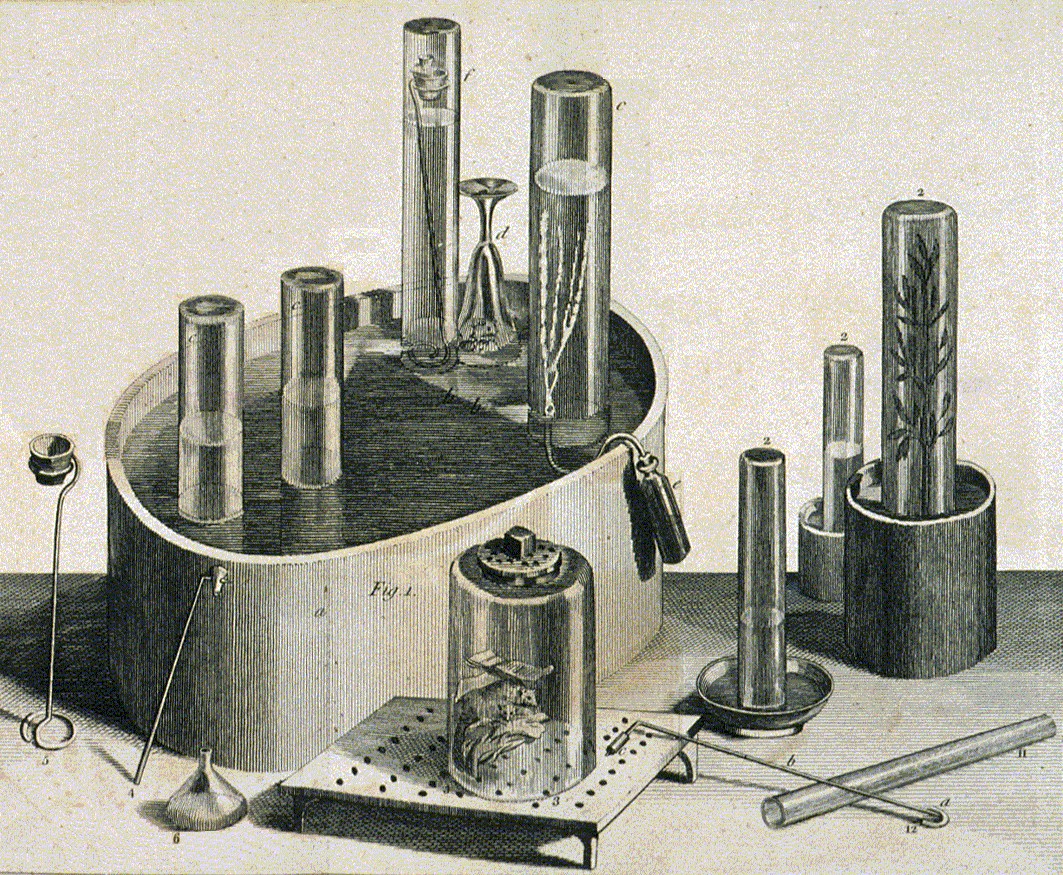
Lent Term began with a suitably sparkling conversation on one of the most important works on air in the history of science, and one of its most interesting characters, Joseph Priestley. In her introduction, Charissa showed the vital role Priestley's Dissenting religious identity played in his life and career, as she traced his biography from England to America via domestic conflagration (perhaps it was too soon to escape last term's theme of fire...). She also gave a brief biography of air, from indivisible classical element to the more complicated understanding of seemingly uniform 'common air' by the eighteenth-century

Our discussion kept returning to the work as a (perhaps slightly fictionalised?) chronicle of the experimental process, guided by sensory experiences, serendipity and an often-surprised narrator. By detailing the apparatus, substances (and creatures), results, and wider ramifications of his researches, Priestley revealed in clear prose how he had been led to his conclusions. His references to other individuals from around Europe demonstrated the interconnectedness of the burgeoning chemical community, and its links to industry. We also thought more generally about chemical language in this period, and the linguistic basis of Lavoisier's reforms in the discipline as providing a new grammar of experiment.

Comparison with Joseph Wright of Derby's An Experiment on a Bird in the Air Pump (1768) showed a different way in which demonstrative experiments were conducted in this period to varied audiences (and eliciting various reactions): a bird, rather than a mouse, is here subjected to a vacuum:


Considering the fate of Priestley's murine experimental subjects led on well to a reading of 'The Mouse's Petition', on behalf of a mouse 'Found in the trap where he had been confined all night by Dr Priestley, for the sake of making experiments with different kinds of air'. These lines in particular seemed to have a contemporary, as well as an eighteenth-century, political as well as a scientific, resonance:
The well-taught philosophic mind
To all compassion gives;
Casts round the world an equal eye,
And feels for all that lives.
Next time we will stick with late eighteenth- and early nineteenth-century pneumatics, but rather than mice being the subject of experimentation on new types of air we will read about what happened when people breathed them in...

Monday, February 06, 2017

Seminar - Emblematic Alchemy

Tara Nummedal (Brown University) will speak at the History and Philosophy of Science Departmental Seminar on Thursday, 9 February at 3:30pm on:

Emblematic alchemy: Michael Maier's Atalanta fugiens (1617/18)

Written by the German physician, courtier and alchemist Michael Maier, Atalanta fugiens (1617/18) offers its readers an alchemical interpretation of the Classical myth of Atalanta as a series of fifty emblems, each containing an image, motto and epigram (in German and Latin), an accompanying fugue (or canon) for three voices, and a Latin discourse explicating the emblem's alchemical meaning. The parts of each emblem and the 214-page quarto book as a whole are meant to work together, with the music, image and text as an interlocking guide to alchemical theory and to the production of the philosophers' stone. In this talk, I will explore the role of sight and image in Maier's alchemical epistemology and situate his book in the visual culture of early modern European alchemy.

Tea and biscuits will be available from 3pm in Seminar Room 1

Seminar Location:
Seminar Room 2
Department of the History and Philosophy of Science
Free School Lane
Cambridge
CB2 3RH

Following the talk we will go to the pub, and on to dinner.

All are welcome!

If you would like to join dinner, please contact Daniel Margocsy (dm753@cam.ac.uk).

Talks - Ordered Universe


Wednesday, February 01, 2017

6th February - Atmosphere


We will begin our series of aerial discussions on Monday 6th February, from 7.30-9pm in the ground floor seminar room of 1 Newnham Terrace, Darwin College. We will be reading:
See you then!

Friday, January 27, 2017

Blame Not Our Author at the Corpus Playroom

The imaginative stage set, which made use of detachable shapes and their shadows.
Last week a few members of the Reading Group went to see this unusual perfomance of a long-lost geometric dramatic work. It was a fascinating evening, full of mathematical and early modern (and early modern mathematical) in-jokes: full credit to cast and crew for taking on such a challenging piece of writing!

I have scanned in the historic notes on the play which were made available to audience members, in case they are of interest to readers of this blog (hopefully they are legible):


Lent Term 2017 - Air


This term the Science and Literature Reading Group takes to the air, as we continue our series of meetings exploring the elements. We will focus on late eighteenth- and early nineteenth-century pneumatics, from eudiometry to aeronautics, considering how air was philosophised, exploited, and consumed.

Meetings take place on Monday evenings at Darwin College from 7.30-9pm. Please note that this term we will be meeting in the ground floor seminar room of 1 Newnham Terrace. All are welcome to join in our wide-ranging and friendly discussions!

The group is organised by Melanie Keene and Charissa Varma. For recaps, further readings, news, and other updates, please visit our blog: https://sci-lit-reading-group.blogspot.co.uk/. We have also recently joined twitter: you can follow us @scilitreadgrp.


6th February: Atmosphere

20th February: Breath

13th March: Flight
  • Thomas Baldwin, Airopaidia (1786), as much as you’d like of 1-164 (‘The Excursion throu’ the Air’), especially 1-14, 29-59, 94-97.

Talk - Curious things sent to Charles Darwin in the post

Francis Neary (Darwin Correspondence Project)

Wednesday 1 February, 13:15-13:45, Milstein Room, Cambridge University Library

All are welcome - no need to book. This is part of our ongoing programme of free tours and pop-up talks. Tours are limited to 15 people and can be booked at curiousobjects.eventbrite.co.uk.

Monday, January 23, 2017

Event - "Maps without borders: Stories of civic science in action"

London, 18th February

This storytelling exhibition showcases powerful aerial maps created by citizens using kites, balloons, and point-and-shoot cameras. We explore how people around the world are harnessing the power of Do-It-Yourself techniques to address local environmental, social and political matters. Sitting around a proverbial campfire, we will tell four stories of women and men, unsung heroes in the U.S. and the Middle East, who have crafted tools and gathered evidence that has reconfigured the perception of space, place, and issues that shape their lives. Their maps take us on the journeys that reveal who created them: their challenges, struggles, and successes in achieving change in their communities. These maps lie at the intersection of technology, science, the environment, and social justice; they reveal the power of engagement and how people are creating alternative narratives of place and transformation. Free event. Wheelchair accessible.

More information and RSVP.

Monday, January 16, 2017

Talk - Fantasy Worlds with Frances Hardinge

Wednesday 8th February, 6 – 7pm followed by a drinks reception

G07, Percy Building, Newcastle University

Join us for an exclusive event with Frances Hardinge, as she discusses the borders between fantasy and reality and her inspiration for her writing with Aishwarya Subramanian from Newcastle University’s Children’s Literature Unit. Her latest novel, The Lie Tree, described as ‘a Victorian Gothic mystery with added paleontology, blasting powder, post-mortem photography and feminism” won the Costa Book of the Year 2015 and audiences will also be treated to a reading from the outstanding novel by Frances as part of this very special event.

This event is hosted by Newcastle University’s School of English Literature, Langauge and Linguistics with Seven Stories: The National Centre for Children’s Books.

Free event. Please book online in advance at: http://www.sevenstories.org.uk/whats-on/events/122952/fantasy-worlds-with-frances-hardinge

This event complements the Children’s Literature Unit’s Postgraduate Visit Day, which will be hosted earlier that day for prospective Masters and PhD students. For more information and to book, visit: http://forms.ncl.ac.uk/view.php?id=11282