Friday, March 03, 2017

Next Term - Water


Our aquatic reading list is coming together for next term (at the moment: Bradbury, Carson, Collins, Oswald): meanwhile, here are the scheduled dates for our meetings.

Additional links to whet (wet?) your appetite:

Noisy Embyros


Dates: 9 – 25 March
Private View: Thursday 16 March, 5.00pm
Noisy Embryos is a multi-channel, audio-visual installation that reflects on the relationship between scientists and the animals they observe by juxtaposing videos of snail embryos generated under laboratory conditions with the 'messiness' of the natural environment and of the process of data collection in the field. It draws on interdisciplinary research carried out by artists Deborah Robinson and David Strang and biologist Simon Rundle during field trips at locations used by naturalist Carl Linnaeus and film maker Andrei Tarkovsky on the Swedish island of Gotland.


Cambridge Science Festival 2017:

Noisy Embryos: From the bane of embryology to indicators of the Anthropocene
Thursday 16 March, 6.30pm-8pm
This interdisciplinary talk links the history of variation in embryology (Nick Hopwood, Cambridge) to the current use of embryos as indicators of climate change (Simon Rundle, Plymouth) to introduce how the audio-visual exhibition Noisy Embryos (Deborah Robinson and David Strang, Plymouth) responds to the uses of embryos in scientific research.
This talk will take place in room RUS110, in the Ruskin Building, no need to book, just turn up. 
We look forward to seeing you at the Ruskin Gallery

Friday, February 24, 2017

Workshop - Beyond Nature in Science and Literature

2nd International Workshop under the 'Hermoupolis Seminars' framework, Syros, Greece, 5-8th July 2017

The International Commission on Science and Literature DHST/IUHPST, the Hellenic Open University and the Institute of Historical Research/ National Hellenic Research Foundation organize a two-days' workshop to study "Beyond Nature in Science and Literature". The CoSciLit workshop is a new addition to the very prestigious "Hermoupolis Seminars" which have been organized for more than 30 years every July on Syros Island.

This workshop follows the successfull 1st workshop organized in 2016 on the theme of "Nature(s), Humans and God(s) in Literature. Representations" and it will be part of series of workshops which will be organized with a specific theme every July.

The venue of the workshop will be the "Historical Archives of the State" in the Town Hall of Hermoulis. Hermoupolis was once the capital of Greece and a city of great cultural, scientific and industrial heritage. Syros Island is very close to Piraeus by boat and an ideal place for a high quality, inexpensive summer visit.

Those who are willing to participate in the workshop with a presentation may ask further information and/or submit an abstract of max. 200 words sending an email to gvlahakis@yahoo.com until 15 May 2017.

Languages: English, Greek, French, German

For participants giving a paper there will be a modest fee of 50 Euros and for those who will attend without a paper a fee of 40 Euros to cover administrative expenses. There will be some hotels with reduced prices on offer for the participants but there are plenty of places, in Hermoupolis or close by, at very convenient prices.

Coffee and refreshments will be offered.

Workshop - Artificial Intelligence, Decision Theory and Severe Uncertainty

Old Combination Room, Trinity College, 9-5, followed by drinks and then dinner.

The following talks are planned for the workshop:

1. Richard Bradley (LSE) - Deciding with Confidence
2. Huw Price and Yang Liu - Heart of DARCness
3. Arif Ahmed (Cambridge) - Rationality and Future Discounting
4. Catrin Campbell-Moore (Bristol) - Risk Avoidance Can't be Accurate
5. Bernhard Salow (Cambridge) - TBC

Morning coffee, lunch and afternoon snacks will be provided for those who RSVP by the end of February (to atb39@cam.ac.uk) but people are welcome to attend even if they don't RSVP by that date. However, if you wish to attend the workshop dinner (which will be at the attendees own cost), please do let me know so that I can make the appropriate reservations. This workshop is funded by the Cambridge Centre for the Study of Existential Risk (http://cser.org/) and the School of Arts and Humanities at the University of Cambridge.

Wednesday, February 22, 2017

Conference Programme - Water

The Northern Nineteenth-Century Network presents
Water, a one-day conference
7 April 2017
9.30-10.30                          Keynote address: Professor John Chartres, University of Leeds (chaired by Professor Karen Sayer)
10.30-10.45                       Refreshments
10.45-12.15                       Parallel panels
Cleanliness and Class
Claire Rennie                        Cleanliness in Early Nineteenth Century Health Regimens
Amanda Sciampacone        'Dirty Father Thames' and the Microscopic Grotesque: Cholera and Water after John Snow
Françoise Baillet                 Picturing the 'Submerged Tenth': Matt Morgan's Representations of Pauperism for the Illustrated London News as Discourse on Class Anxiety. The Example of 'A Soup-Kitchen in Ratcliff-Highway' (1867)'
Slavery and Liberation
Ciarán Rua O'Neill              Bearing Vessels of Lustration and Vases of Libation: Water Carriers in Nineteenth-Century Painting
Melissa Gustin                     Go Down, Moses: The Fountain Forms of Edmonia Lewis's Forever Free
Eva McGrath                        Crossing the River into Freedom: Borders, Form and Maternal Connection in Harriet Beecher Stowe's Uncle Tom's Cabin
Water Stories
Haythem Bastawy               One Sea, Too Many Stories: The Thousand and One Nights in European Myths and Fairy Tales
Tess Somervell                    Sea Rocks and Inland Waters: Wordsworth's Ocean in Motion
Simon Rennie                       From 'sparkling rills' to 'ocean grave': Water Imagery in the Poetry of the Lancashire Cotton Famine, 1861-65
12.15-1.15                          Lunch
1.15-2.15                            Presentations by Light Vessels Project
Karen Sayer                          Between Water and Land: Illuminating Light Vessels in the Long Nineteenth Century
Elise Liversedge & Mary Hooper
LAST STATION: Artistic Responses to Bodies of Water & Waterways
2.15- 3.45pm                    Parallel panels
Policies of Water
Andrew McTominey          Two Bad Neighbours? The Civic Rivalry of Leeds and Bradford c.1850-1890
Rachel Hurley, James Rothwell & Jamie Woodward
Contaminated Cottonopolis: Legacies of Historical Industry in Manchester's River Network
Samuel Grinsell                   Constructing the Nile Valley: Empire, Environment and Building, 1880s-1920s
Writing Water
Marco Canani                       'One whose fate was writ in water': Percy Bysshe Shelley and the Water Sublime
François Ropert                   'The wave that breaks against a forward stroke': The Metronomics of Swimming in A.C. Swinburne's Sea Poems
Joan Passey                          The Sound of the Sea: Sonic Gothic Seascapes in Victorian Cornwall
Watering Places
Joe Davey                              Sailor Criminality in a Port City – Bristol 1850-1914
Joanne Knowles                   'Favourite and Popular Watering Places', Piers and Other Waterside Attractions
Martha Cattell                      Whale Watching: Vision and Visuality in Nineteenth Century Arctic whaling marine paintings
3.45-4.15 pm                    Refreshments
4.15 – 5.45 pm                 Parallel Panels
Transport and Industry
Helen-Frances Pilkington  "Being scientific"? Clouds in hot air balloon narratives in the eighteenth and nineteenth centuries
Jodie Matthews                    Canals in Nineteenth-century Literary History
Richard Byroms                  William Fairbairn's Hydraulic Engineering
Dangerous Waters
Stephen Basdeo                   The Role of Water in GWM Reynolds' The Mysteries of London (1844-48)
Odile Boucher-Rivalain     The Ambiguity of Water in George Eliot's The Mill on the Floss (1860)
Laura Ettenfield                   The Octopussy: Exploring Representations of Female Sexuality and Animality in Victor Hugo's The Toilers of the Sea (1866) and The Laughing Man (1868)
Close of conference

Supported by the British Association for Victorian Studies (BAVS)

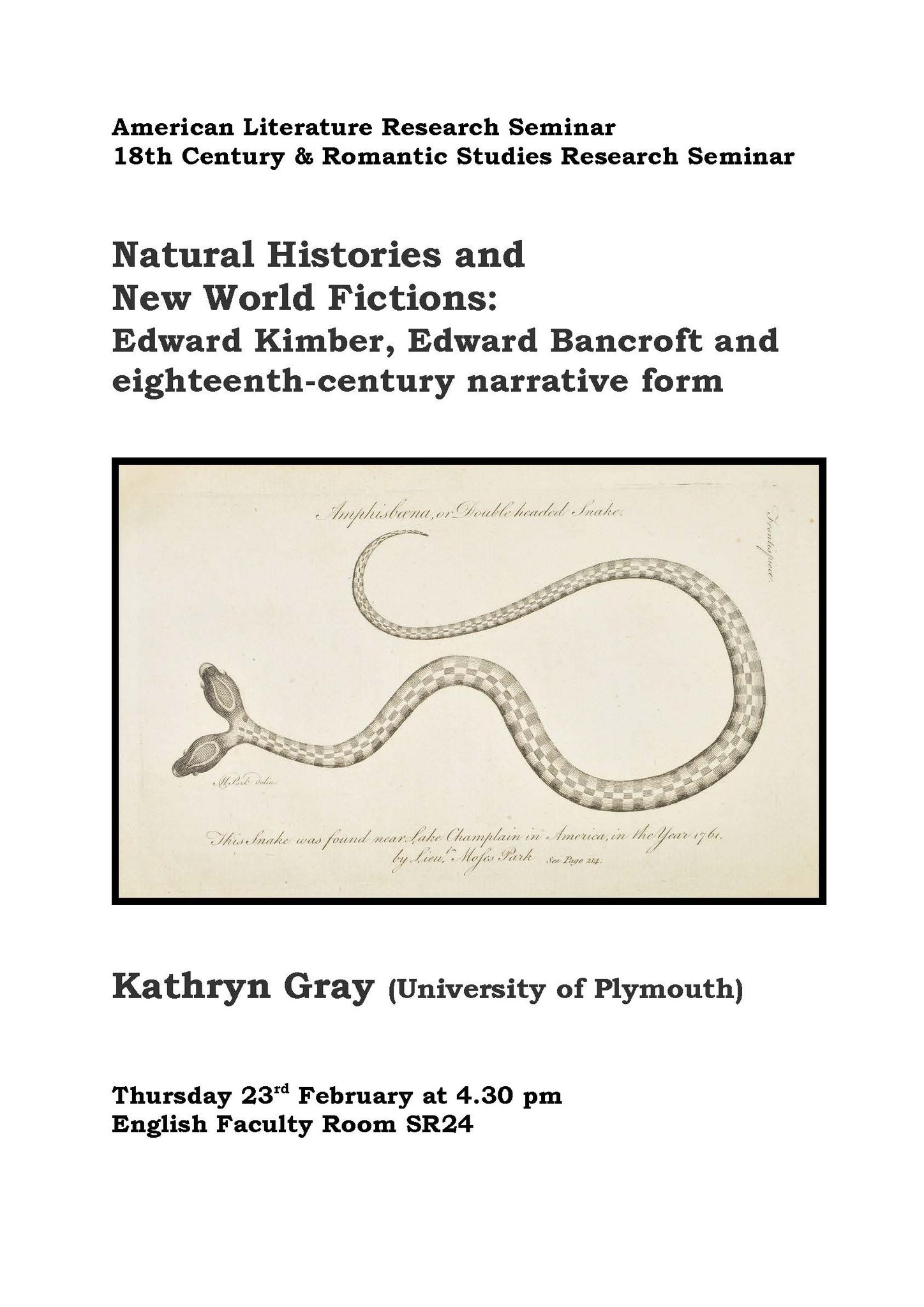
Talk - Natural Histories and New World Fictions


13th March - Flight


Our final meeting of term takes flight as we escape the earth to travel amongst the clouds with an early account of a ballooning adventure. Hope to see you then!
  • Thomas Baldwin, Airopaidia (1786), as much as you’d like of 1-164 (‘The Excursion throu’ the Air’), especially 1-14, 29-59, 94-97.

Recap - Breath

Our second meeting of this term was 'a gas', as we explored the poetics and possibilities of pneumatic medicine. Our discussion of Polwhele's 'Eclogue' focused on a few themes:
  • 'Aero-medical science'
We considered the optimism around new gaseous discoveries and technologies, and the confidence that new kinds of air could be used as therapy and remedy. We explored the Romanticism of this kind of auto-experimentation, and the key role of figures such as Davy and Beddoes, and places such as the Pneumatic Institution. Comparison between epistolary, prose, and our set poetic descriptions of the effects of inhaling nitrous oxide, demonstrated how Polwhele drew on these other accounts, but pushed them to a satiric extreme.
  • Scientific poetry
We also set the poem in the context of a long 18thC tradition of verses on the Universe, or Botanic Garden, from Pope to Erasmus Darwin. We thought about the different poetic forms this corpus engaged with: some epic, some didactic, some comic (as here). Overall, we discussed how poetry like this formed a key part of (elite) British scientific culture at the time, including commentary on recent discoveries, and conveying accurate information (via footnotes, etc.). Indeed, the use of footnotes by Polwhele was a key topic of conversation.
  • Politics and fashion
We thought about how these publications were written in the shadow of the French Revolution, Terror, and Napoleonic Wars: in its very name the conservative Anti-Jacobin Review (where our text first appeared) echoed these concerns. We discussed the contrasting political commitments of conservative Polwhele with the more progressive politics of Beddoes, etc., hence the criticism of them under the guise of this poem. In general, we also thought about the contemporary fad or fashion for Laughing Gas (songs, satirical prints), and made comparisons with Davy's subsequently fashionable lectures at the Royal Institution.
  • The poem's success?
We agreed we had all enjoyed reading the poem, and its often superbly awful choice of rhymes; but that perhaps not all of its references were that easy to 'get', and that not all of its humour survives over two hundred years later. We thought about the different voices and characters of the (real) people depicted, and whether or not the author - with contrasting poetic styles - had succeeded in conveying this variegated and personalised bodily experience effectively. As the only stimulant we had to hand was sugar (in the form of a birthday cake for Simon), perhaps a full answer to that last question was not possible.
We closed the evening with the promised performance of two historic songs about Laughing Gas: the songs can be downloaded here and here from the Wellcome Images site.

Yours truly at the piano, with members of the group looking on. Photograph by Charissa.
Laughing Gas sheet music. Photograph by Charissa.

Monday, February 20, 2017

Talk and book signing: 'Cunning, Killer Orchids: sex, science, fiction and Darwin'


Jim Endersby will be giving a free talk based on his new book - Orchid a cultural history - on 25th Feb at 2pm in the auditorium of the Sainsbury Laboratory at the Botanic Garden. Tickets are free but pre-booking is required. Please collect a ticket from the Garden Ticket Offices or email enquiries@botanic.cam.ac.uk or call 01223 336265.

The talk will last about 45 minutes, followed by questions and a book signing.

More about the book:
Revealing the allure and wonder of orchids, following their story through history and exploring how key themes of science, empire, sex and death have shaped orchids and how orchids, in return have shaped our own investigations and associations. Find out how Darwin's theory of evolution became intimately entangled with the story of the orchid as well as the part they have played in our culture.